Board games with kids
Ages five and ten, and a few that work when the ages mix.
The hardest table to seat is not a group of hardcore strategy hobbyists. It is a five-year-old and a ten-year-old at the same table.
A five-year-old cannot handle walls of text, hidden hand management, or waiting three minutes for someone else to calculate their move. A ten-year-old is immediately insulted by simplistic baby games that offer no real decisions.
If you pick the wrong box, the younger child gets frustrated, the older child gets bored, and everyone retreats to their screens.
Here are the games that actually bridge the gap, tested by parents across real kitchen tables.
The Stepping Stone
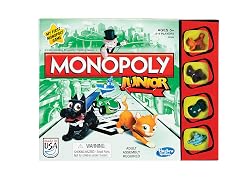 Monopoly Junior
Monopoly Junior works where standard Monopoly fails because it strips away everything that ruins the adult game. All money is simplified to one-dollar bills, properties are amusement park rides, and the game automatically ends in twenty minutes when the first player runs out of money. It teaches basic counting and turn-taking without the four-hour bankruptcy misery of the classic box.
Reaction and Visual Matching (No Reading Required)
These games level the playing field because visual speed and spatial recognition do not depend on age. Adults frequently lose to children fair and square.
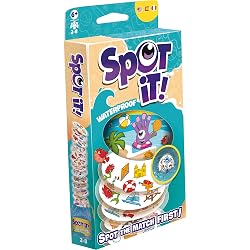 Dobble (Spot It!): A deck of circular cards with whimsical symbols. The mathematical magic is that any two cards in the entire deck always share exactly one matching symbol. You flip cards and race to shout the match. It takes ten seconds to explain, packs into a palm-sized metal tin, and five-year-olds will routinely beat their parents.
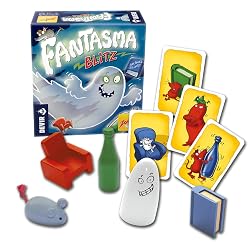 Ghost Blitz: Five wooden items sit on the table: a white ghost, green bottle, red chair, blue book, and grey mouse. You flip a card showing two colored items.
 - If one item matches its real color, grab it!
- If neither matches, grab the item whose color and shape are completely missing from the card!
It creates delightful cognitive static and sharpens logical reflex speed for both kids and adults.
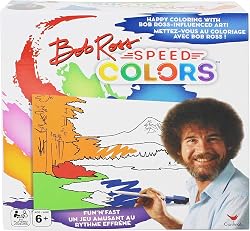 Speed Colors: Each player has a double-sided card: one side in full color, the other a black-and-white outline. You memorize the colors, flip the card over, and race to color in the sections using dry-erase markers. Great for motor skills, memory, and fast creative fun.
Friendly Spite Cards
Children quickly learn to love a little lighthearted mischief, provided it does not lead to tears.
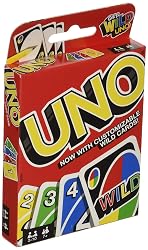 Uno: A worldwide standard for a reason. Simple color and number matching with the universal satisfaction of forcing someone to draw four cards.
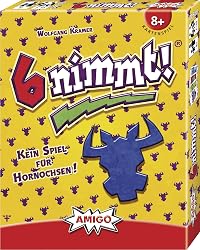 6 nimmt! (Take 6!): Everyone secretly picks a numbered card and reveals simultaneously, placing them into four rows in ascending order. If your card is the sixth in a row, you have to collect all five cards and their penalty "bullheads." It teaches numerical sequencing and calculated risk without requiring reading.
Deduction and Light Strategy
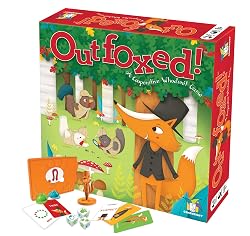 Outfoxed!: The undisputed king of cooperative deduction for young kids. A mischievous fox stole a pot pie and is running for the exit. Players roll dice to move through the neighborhood, uncover suspect cards, and search for clues.
 - The brilliant touch is a physical plastic "clue decoder" slider: you insert a clue tile into the device, open the window, and green or red dots reveal whether the thief is wearing a hat, a scarf, or glasses.
- Because it is 100% cooperative, the whole table celebrates or groans together.
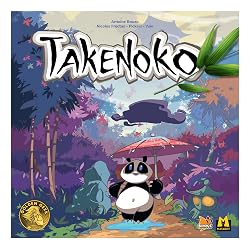 Takenoko: A stunning, tactile game about managing the Emperor of Japan’s bamboo garden. Players take turns moving a giant hungry wooden panda and a dedicated gardener. Colorful wooden bamboo segments physically stack up on the board. A five-year-old can happily feed the panda while a ten-year-old plans secret objective cards for points.
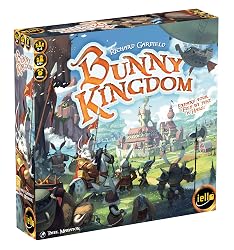 Bunny Kingdom: Designed by Richard Garfield. You draft cards to place rabbit miniatures onto a grid map, connecting rabbit fiefdoms to multiply territory by resources. Better suited for eight-to-ten-year-olds who have grasped basic multiplication.
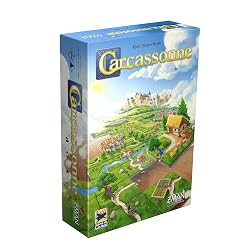 Carcassonne: Play without the complex "farmers" rule. Kids love laying down winding roads, medieval castles, and monasteries, and seeing a sprawling kingdom take shape on the carpet.
Physical Chaos and Laughs
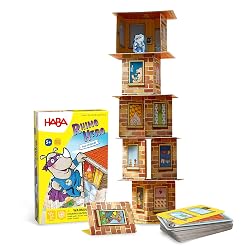 Rhino Hero: A 3D tower-building dexterity game. Players fold cardboard walls and lay down roof cards, building a teetering high-rise. Special cards force players to move the heavy wooden Super Rhino figurine higher up the tower. When the whole skyscraper collapses, everyone laughs.
- Ribbit! (Turtle Race): Everyone holds a secret card showing which colored turtle they want to win. You play cards to move turtles forward, but turtles can crawl on top of each other! When a bottom turtle moves, all the turtles riding its shell travel for free.
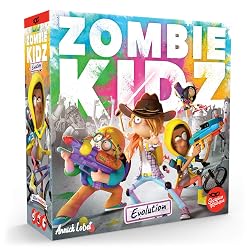 Zombie Kidz Evolution: The highest-ranked children's game on BoardGameGeek, and the first true "legacy" game for kids. Every time you play, you put stickers on a progress chart. As you earn badges, you open mystery sealed envelopes that permanently add new powers, special zombie types, and expanded rules. Kids become fiercely invested in finishing the campaign.
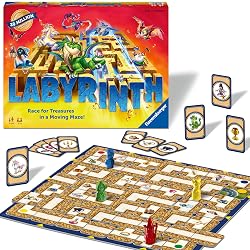 Labyrinth: A timeless Ravensburger classic. Players take turns sliding an extra maze tile into the edge of a grid, shifting entire rows of walls to open pathways to treasures. It scales across wide age differences — even a six-year-old and a teenager can compete on equal footing.
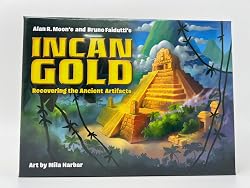 Incan Gold (Diamant): A pure push-your-luck treasure hunt. Players explore an ancient temple turn by turn, sharing discovered gems. Each turn, you secretly decide whether to stay and explore deeper or flee back to camp with your loot. If two matching hazard cards appear, everyone left in the temple drops their gems and flees empty-handed. Pure push-your-luck laughter.
What Happened to the Old Illustrated Adventure Boards?
Parents frequently ask why they cannot find the sprawling adventure games of their childhood — the big, beautiful illustrated adventure boards depicting pirate islands, sci-fi star systems, or wild west frontiers, where rolling dice moved your hero along winding paths through traps and encounters.
Modern toy shops largely abandoned them for either sterile clones (like basic Snakes & Ladders) or complex rule-heavy card games.
If you are looking for that specific vintage adventure feel on modern shelves:
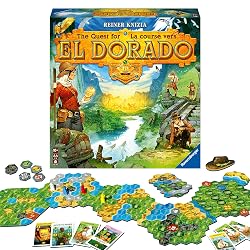 The Quest for El Dorado: Designed by Reiner Knizia. A thrilling family race through jungle, rivers, and caves using accessible card drafting. Beautiful modular terrain tiles give kids the tactile thrill of an expedition map.
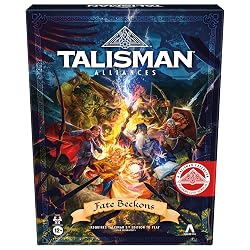 Talisman: The definitive fantasy adventure track where heroes roll dice, draw encounter cards, fight monsters, and level up on an illustrated board.
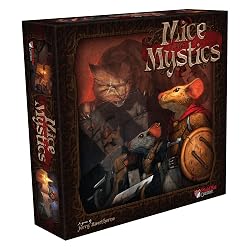 Mice and Mystics: A cooperative story-book game where the board is a literal chapter-book and players control miniature mice fighting through castle drains.
As an Amazon Associate we earn from qualifying purchases.