Lovecraft on the table
Three related games. Pick the job, not the mythos.
Fantasy Flight Games has built an entire tabletop empire around H.P. Lovecraft’s Cthulhu mythos. All three of their flagship games feature the same 1920s detectives — Roland Banks, Wendy Adams, Daisy Walker — hunting dark cultists and staring down tentacled abominations.
Because the art and character cards look identical across the line, newcomers assume the three games are just different box shapes of the same experience.
They are not. They are three completely different genres of games, built for different player counts, different budgets, and vastly different tolerances for rulebook complexity.
Here is what you actually need to know before spending your money.
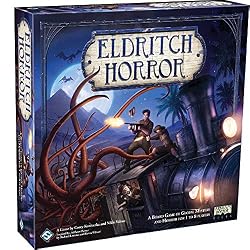 Eldritch Horror: The Planetary Crisis
Eldritch Horror is a massive, sprawling cooperative game of global crisis management. You travel across a world map from London and Buenos Aires to the pyramids of Egypt and the Antarctic ice sheets, closing dimensional portals, solving ancient mystery cards, fighting monsters, and trying to stop an Ancient One (like Cthulhu or Azathoth) from waking up.
- The Player Count Reality: The game mathematically balances its doom track, monster spawns, and gate appearances around specific player count tiers: specifically 4 or 8 investigators. If there are only two of you, playing one investigator each leaves the map far too vast — the doom track will run out while you are still crossing the Pacific. The standard, proven way to play with two people is for each player to control two investigators simultaneously (four on the board).
- The Expansion Catch: The publisher notoriously trimmed down the base game before release. The base encounter decks are so thin that by your third game, you will be drawing the exact same city encounter cards in Tokyo and San Francisco. The small-box expansion Forsaken Lore is virtually mandatory: it doubles the encounter and mystery decks, turning a repetitive game into a rich sandbox. To reach its true potential, most fans own three or four expansions.
- The Rules Hurdle: Eldritch Horror comes with both a rulebook and a separate rules reference encyclopedia. Expect your first session to take three hours of rules reading, three hours of play, and another hour of realizing half the things you did were illegal. It is fantastic if one person acts as the dedicated "keeper" of the rules, but overwhelming for casual beginners.
- Plot Style: Episodic and emergent. You are not following a scripted novel; you are telling a chaotic emergent story through hundreds of flavor text cards.
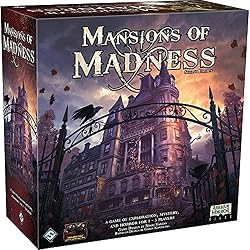 Mansions of Madness: The Atmospheric Mystery
If Eldritch Horror is an atlas, Mansions of Madness is a haunted house. You play a small group of investigators exploring a mansion, a foggy dockside street, or an overgrown cemetery, searching rooms for clues, solving puzzles, and evading terrifying creatures.
- The Companion App: The defining feature of the second edition is a free app (run on a tablet, laptop, or phone). The app acts as the Dungeon Master: it narrates the story, plays creepy ambient music, tells you which modular room tiles to lay down, manages monster behavior, and runs sliding-tile puzzles on the screen.
- Why It Is the Best On-Ramp: This is the easiest Lovecraft game to teach. Because the app handles the complex rules, monster damage calculations, and map setup, you can sit down with complete novices and have them playing ten minutes after opening the box.
- The Drawbacks:
- Price: The box is packed with dozens of plastic miniatures and modular tiles, pushing the price tag over $100.
- Low Replayability: The base box contains only four narrative scenarios (with two more available as paid app DLC). Once you solve a murder mystery and know who the cultist is, playing that scenario again loses the thrill of the unknown.
- Screen at the Table: Some tabletop purists dislike having a tablet in the center of the table.
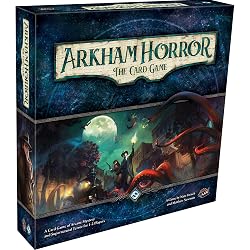 Arkham Horror: The Card Game: The Campaign Masterpiece
Designed from the ground up specifically for one or two players, this is widely considered the artistic pinnacle of the entire Lovecraft catalog.
You and your partner build custom 30-card decks representing your investigator's physical tools, supernatural relics, allies, and personal psychological trauma. You then play through sequential, multi-part narrative campaigns where your decisions and failures permanently alter the world.
- Persistent Narrative: If you fail to save a town in scenario two, it is burned to the ground in scenario five. If your investigator suffers mental breakdown, you take permanent mental trauma that reduces your maximum sanity and forces dark weakness cards into your deck for the rest of the campaign.
- The Chaos Bag: Instead of rolling dice, skill tests require reaching into an opaque cloth bag to draw a token (like +1, -2, or the dreaded Auto-Fail tentacle). You can mitigate your odds through card play, and the game allows you to adjust the token mix (Easy, Standard, Hard, Expert) to calibrate the cruelty to your taste.
- The Drawbacks:
- The Financial Trap: The core set is essentially an appetizer — a short three-scenario tutorial. To experience the real game, you need to buy full campaign expansions (like The Dunwich Legacy or The Path to Carcosa), each adding eight massive scenarios.
- Deckbuilding: Between games, you spend earned experience points to upgrade your deck with better cards. If you dislike spending twenty minutes tinkering with card combos between sessions, this will feel like homework.
The Buying Verdict
Match your purchase to your real life, not your fantasy:
Buy Mansions of Madness if you want an atmospheric, cinematic mystery evening for dates or friends with zero rules headaches, and you don't mind the companion app. Buy Arkham Horror: The Card Game if there are two of you who want an unforgettable narrative campaign and enjoy customizing character decks over months of play. Buy Eldritch Horror if you have four dedicated players ready for a deep, challenging, three-hour global strategic puzzle, and you are prepared to buy the Forsaken Lore expansion to complete the core game.
As an Amazon Associate we earn from qualifying purchases.