Board games: Beyond the gateway
When Catan and Ticket to Ride get too simple: deep engines, space empires, narrative campaigns, and tactical duels.
Every board game collection starts the same way. You bring home Catan, Carcassonne, or Ticket to Ride. You teach them to your friends in fifteen minutes, trade wood for sheep, connect train routes, and discover the joy of analog game night.
Then, six months later, an itch develops. The dice in Catan start feeling arbitrary. Laying roads feels automatic. You realize your game group is ready for something with real strategic weight: systems where luck takes a backseat to long-range planning, where every decision has compound interest, and where victory feels earned rather than gifted by a lucky card draw.
The hobby calls this transition "stepping beyond the gateway." Yet moving into heavier games is where most buyers waste money on intimidating rulebooks and three-hour shelf trophies that nobody ever wants to play twice.
Here is an honest buyer's guide to the timeless heavy-hitters and intermediate classics that genuinely earn their table time: what they actually feel like to play, who they are built for, and which box belongs on your shelf.
Looking for games tuned for a couple? Check Board games for two. Want fast lunchtime games for colleagues? Read Board games: What IT offices actually play.
---
The Timeless Euro Engines
If you want pure cognitive satisfaction, razor-sharp resource management, and virtually zero dice luck, these three titles represent the pinnacle of modern economic design.
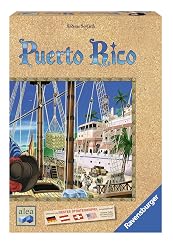 Puerto Rico
The masterclass of variable role selection.
First released in 2002, Puerto Rico spent years sitting at the absolute top of the global BoardGameGeek rankings. It introduced a game mechanism so elegant that designers have borrowed it ever since: the shared action draft.
- The Hook: You develop the island of Puerto Rico by planting crops (corn, indigo, sugar, tobacco, coffee), constructing civic buildings, and loading cargo onto merchant ships bound for Europe. There are no individual turn phases. Instead, the active player chooses one of the available roles — Builder, Settler, Mayor, Producer, Trader, or Captain. Every player at the table then takes that action, while the chooser gets a small unique privilege.
- The Table Reality: Timing is everything. Picking the Captain forces a round of goods shipping: cargo space is strictly limited, and any player who cannot fit their perishable harvest onto the boats loses their inventory. You will watch your opponents squirm as you force a shipment they cannot participate in, filling the hulls with your own high-value coffee barrels.
- Who it is for: Groups of 3 to 5 players who appreciate clockwork economic balance, minimal downtime, and strategic foresight. It scales exceptionally well because every player stays active on every turn.
- The Catch: The game is completely unforgiving of rookie blunders. An inexperienced player who blindly triggers production can inadvertently hand their neighbor thirty points.
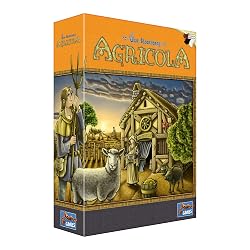 Agricola
The high-stakes survival farm where every grain counts.
Designed by Uwe Rosenberg, Agricola took the cozy idea of running a 17th-century family farm and turned it into one of the most intense, suspenseful worker-placement engines ever created.
- The Hook: You and your spouse begin with a two-room wooden shack and a patch of unplowed dirt. Over fourteen brisk rounds, you place worker tokens to gather wood and clay, plow and sow grain fields, build fences, breed livestock (sheep, wild boar, cattle), and expand your family home.
- The Strategic Crisis: At periodic harvest intervals, the grim reaper arrives: you must feed your family. Every family member requires two units of food. If your harvest falls short, you take beggar cards, resulting in punishing point penalties. You are constantly balancing long-term infrastructure investment against immediate caloric survival.
- The Table Reality: Unlike gentle gateway builders where everyone gathers abundance, Agricola is an engine of scarcity. If an opponent takes the single "accumulate 6 wood" space before your turn, your entire building plan for the year collapses. The tension is palpable, and scraping together a warm stone farmhouse with thriving livestock feels like a genuine triumph.
- The Catch: If anyone at your table gets stressed by tight resources or strict feeding deadlines, this will feel like grueling overtime labor. For a gentler, more forgiving worker-placement gateway, look to Stone Age instead.
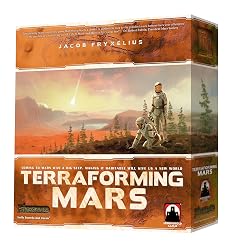 Terraforming Mars
The engine-building juggernaut of 200 unique projects.
Few games in modern history have captured the tabletop world like Terraforming Mars. It took the dry scientific dream of making the Red Planet habitable and transformed it into the ultimate card-driven industrial race.
- The Hook: You control a massive rival corporation (from mining conglomerates to bio-engineering cartels) funding global terraforming parameters: raising planetary temperature, generating atmospheric oxygen, and placing ocean tiles.
- The Infinite Card Variety: The game contains well over 200 project cards, and not a single card is repeated. You might crash an asteroid into an opponent's plant forest, introduce genetically engineered lichen to tundra basins, or tether a space elevator to capture Phobos. Every game your engine takes a completely different technological shape.
- The Table Reality: You begin with meager production, barely affording a single satellite. By generation eight, your resource board is an unstoppable economic engine generating mountains of heat, energy, and megacredits every round. Watching the dry barren board fill with lush greenery tiles and glittering domed cities is intensely rewarding.
- The Catch: The game components (flimsy player mats and metallic cubes) feel decidedly budget given the box price. Grab a set of dual-layer acrylic player overlays to prevent accidental bumps from destroying your resource tracking.
---
Galactic Expansion: From 20 Minutes to 8 Hours
For players who love science fiction, the space theme offers the widest spectrum of complexity in all of tabletop gaming — ranging from pocket card drafting to day-long political space operas.
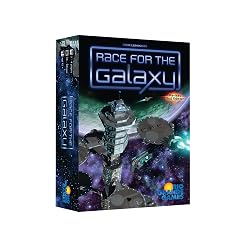 Race for the Galaxy
The lightning-fast 25-minute galactic card engine.
Designed by Tom Lehmann, Race for the Galaxy is widely considered one of the greatest card games ever published. Veteran players routinely log hundreds — sometimes thousands — of plays without ever seeing the strategy grow stale.
- The Hook: You build a sprawling interstellar civilization using cards that serve a brilliant triple purpose: cards in your hand are worlds or technologies you can construct, but they are also the literal currency you discard to pay for them.
- Simultaneous Action Selection: Every round, all players secretly select one of five action phases (Explore, Develop, Settle, Consume, or Produce). Only the chosen phases occur this round, and all players execute them simultaneously. If you correctly predict that your rival will choose Produce, you can select Consume to double your victory points without wasting an action generating goods.
- The Table Reality: Because all actions resolve simultaneously, there is zero downtime. A four-player game finishes in twenty-five minutes, leaving the table immediately demanding a rematch. Tableaus diverge dramatically: one player builds an empire of military conquerors, while another creates an economic trade engine that strips card decks bare.
- The Catch: The hieroglyphic icon system. The cards use dense shorthand iconography to keep the layout language-independent. Your first two games will feel like deciphering an alien transmission. Once the symbols click, you will never want to play traditional slow card drafting again.
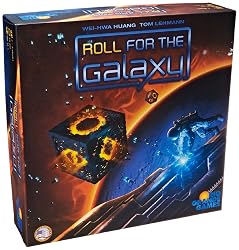 Roll for the Galaxy
The tactile dice-management evolution.
If you love the simultaneous action selection of Race for the Galaxy but want custom dice and a more approachable interface, Roll for the Galaxy is the definitive alternative.
- The Hook: Your population is represented by dozens of colorful custom dice. You roll your dice behind secret player screens and assign them to tasks: exploring new tiles, researching technological developments, settling colony worlds, producing goods, and shipping them for victory points.
- The Dice Worker Allocation: White dice represent basic colonists, yellow represent geneticists, red represent military commanders, and purple represent consume specialists. You use worker manipulation abilities to reassign dice from one phase to another, adapting your strategy to whatever faces come up on the roll.
- The Table Reality: Shaking a cup full of twelve chunky dice behind a screen and secretly setting your phase tiles gives every round an infectious tactile buzz. Just like its card-based sibling, turns resolve simultaneously, keeping gameplay brisk and interactive.
- The Catch: It requires more table space and setup than the card version, and players who despise any dice-rolling variance may still prefer the pure card drafting of Race.
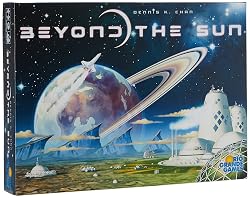 Beyond the Sun
The collective space tech tree masterclass.
In most civilization games, tech trees are private menus hidden on personal player sheets. Beyond the Sun turns the scientific tech tree into the central communal board itself.
- The Hook: As Earth's biosphere expires, rival human factions unite to explore deep space. On your turn, you move your single action pawn to an available tech on the central board. When you research a new breakthrough, you draw cards from the discovery deck and choose which brand-new Level II, III, or IV scientific advance permanently anchors to the tree.
- The Shared Tree Tension: Researching a tech creates a powerful new worker-placement action for the entire table — but the discovering player gets exclusive access and immediate bonus benefits. Meanwhile, you are building spaceships, warping fleets across modular deep-space systems, and claiming control of newly discovered exoplanets.
- Who it is for: Gamers who adore tech trees in 4X computer games like Civilization or Stellaris. It is razor-sharp, visually lucid, and driven by clean Euro worker-placement with zero combat dice.
- The Catch: The art and graphic design are austere and clinical. It looks like an engineering schematic rather than a flashy space battle, but mechanically it is an undisputed modern masterpiece.
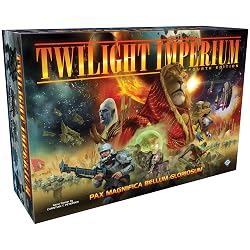 Twilight Imperium: Fourth Edition
The legendary eight-hour space opera titan.
There is no game on earth quite like Twilight Imperium. It is not merely a board game; it is an entire dedicated Saturday event that players plan weeks in advance.
- The Hook: Three to six players command seventeen wildly asymmetric alien species — from the merchant barons of the Emirates of Hacan to the terrifying biomechanical virus of the Nekro Virus. You build dreadnought battle fleets, conquer planetary systems, research exotic technologies, and vie to claim the galactic imperial throne of Mecatol Rex.
- The Political Drama: What elevates Twilight Imperium into legend is the Agenda Phase. Once the galactic council convenes, players vote on sweeping galactic laws that permanently alter game rules. Bribes, promises of military protection, promissory note card exchanges, and cold-blooded political betrayals happen openly across the table.
- The Table Reality: Battles are massive, but wars are rarely won by pure force of arms. Victory points come from fulfilling public secret objectives (economic, political, territorial). A six-player game takes 6 to 8 hours, and you will walk away with epic stories of last-round turncoat maneuvers that your group will recount for years.
- The Catch: The sheer commitment. You need 6 players willing to clear a full day, learn a comprehensive rules system, and endure grueling negotiations without personal grudges.
---
High-Seas Sandboxes & Dark Campaigns
When your group wants to step away from tidy spreadsheets and dive into rich narrative worlds with lingering consequences.
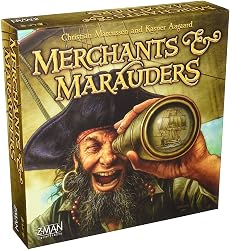 Merchants & Marauders
The definitive open-world Caribbean piracy sandbox.
If you grew up loving classic computer games like Sid Meier's Pirates!, this is that exact swashbuckling dream realized on a massive board.
- The Hook: You captain a small sailing sloop in the 17th-century Caribbean with a handful of gold and a unique captain card. How you achieve glory is entirely up to you: become a wealthy merchant captain buying sugar in Havana and selling it in Port Royal, or hoist the Jolly Roger, raid trade galleons, and hoard stolen Spanish doubloons.
- The Thematic Reality: The world is living and reactive. Plundering a French merchant puts a French bounty on your head, sending royal naval frigates hunting you across the map. Combat is cinematic and granular: you roll to aim for your enemy's hull, mast, or crew, choose whether to fire chain-shot or grapeshot, and can board enemy decks for cutlass duels.
- Who it is for: Groups of 2 to 4 players who want a rich, atmospheric Saturday adventure full of tavern rumors, treasure hunting, merchant convoys, and naval combat.
- The Catch: It is long, rolling lots of dice, and high in luck. A sudden tropical hurricane can wreck your frigate, and a rival pirate can blast your hold to driftwood. It is an adventurous story machine, not a sanitized mathematical contest.
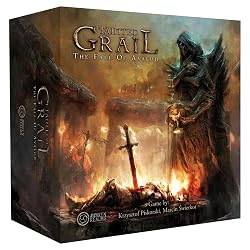 Tainted Grail: The Fall of Avalon
The 50-hour grimdark Arthurian campaign masterpiece.
Designed by Awaken Realms, Tainted Grail is the gold standard for mature, narrative-driven campaign board games.
- The Hook: King Arthur is dead. The guardian menhirs keeping the mystical Red Death and Wyrdness at bay are fading into darkness. You play four flawed, desperate survivors — not glorious knights, but the outcasts left behind when the real heroes never returned.
- The Exploration Journal: The game features an enormous spiral-bound exploration journal with thousands of branching narrative choices. Every location tile you discover has secrets to investigate, moral dilemmas, and branching consequences. If your party burns down a bridge in chapter two, that shortcut is permanently gone when you return in chapter seven.
- The Survival Pressure: Combat and diplomacy are driven by unique deck-building card chains where you string together attacks or arguments. Surviving requires managing your energy, food, and sanity while lighting ancient statues before the Wyrdness consumes the land.
- Who it is for: Solo players or dedicated duos/groups who want an immersive, book-length dark fantasy epic across 30 to 50 hours of campaign play.
- The Catch: It is relentlessly punishing. If you do not manage food resources carefully, your party will starve in the mist. It is an emotional marathon of survival, not a light dungeon crawl.
---
Masterclass Tactical & Historical Duels
When you have exactly one opponent, a table cleared for action, and an hour or two for razor-sharp tactical maneuvering.
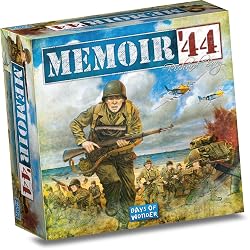 Memoir '44
Accessible historical combat on oversized hex battlefields.
Designed by Richard Borg and published by Days of Wonder, Memoir '44 commemorates the D-Day landings and the critical battles of World War II.
- The Hook: The battlefield is divided into three distinct operational sectors: Left Flank, Center, and Right Flank. On your turn, you play a Command card from your hand that dictates which sector you can activate (e.g., "Issue orders to 3 units on your Left Flank"). You order your plastic infantry, armor, and artillery miniatures, navigate terrain hexes (bunkers, rivers, bocage hedgerows), and roll custom combat dice.
- The Ergonomic Magic: Setup takes five minutes. The rulebook is clean and intuitive, making it the single best gateway wargame in existence. Scenarios are historically grounded and asymmetrical — playing the Allies storming Omaha Beach feels completely different from commanding German defenders entrenched on the cliffs.
- Who it is for: Duos of any experience level who love military history, miniature battles, and fast tactical maneuvering without cumbersome rulebook disputes.
- The Catch: Dice rolls introduce combat volatility. You can maneuver your Sherman tanks into textbook flanking position only to roll three misses. Players embrace the chaos of wartime command or plan defensively.
 Sekigahara: The Unification of Japan
The wooden block samurai duel of hidden strength and fickle loyalty.
Published by GMT Games, Sekigahara captures the decisive seven-week campaign in 1600 that unified feudal Japan under the Tokugawa shogunate.
- The Hook: All military forces are represented by upright rectangular wooden blocks. The unit types (infantry, cavalry, arquebusiers) and clan crests (Tokugawa, Ishida, Mori, Maeda, etc.) are printed on only one side facing you. Your opponent sees only a wall of anonymous black and gold blocks.
- The Fog of War & Bluffing: Having a block on the battlefield does not guarantee it will fight. To deploy a clan into combat, you must discard a matching clan card from your hand. If you march an imposing army of five blocks into a castle, your opponent must guess: are you holding the cards to command them, or are you executing a cold-blooded samurai bluff?
- The Loyalty Challenge: Traitorous allies were the reality of the Sengoku Jidai. If your rival commits a clan to battle, you can play a Loyalty Challenge card. If they cannot produce an additional card proving their daimyo's allegiance, that unit immediately defects and attacks its own general.
- Who it is for: Two players who want a three-hour historical duel that feels like a cross between high-stakes poker and classical military maneuvering with zero combat dice.
- The Catch: Card management is unforgiving. If your hand gets clogged with mismatched clan crests, your armies are paralyzed until you cycle your deck.
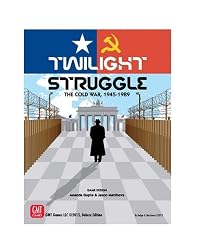 Twilight Struggle
The forty-five-year Cold War dance of brinkmanship.
For years the undisputed number-one ranked game on BoardGameGeek, Twilight Struggle is widely regarded as the pinnacle of historical card-driven design.
- The Hook: Two players take the mantles of the United States and the Soviet Union from 1945 through the fall of the Berlin Wall in 1989. The battleground is the entire globe: funding coups in South America, spreading diplomatic influence through Western Europe, racing to the moon, and navigating regional proxy conflicts.
- The Agony of the Event Card: Every card represents a real historical event (the Cuban Missile Crisis, the Marshall Plan, the Vietnam War) and carries an Operations point value. The genius mechanism: if you play an opponent's card for its Operations value, their event triggers anyway. Every turn forces painful compromises: "Which enemy disaster can I afford to trigger right now to secure influence in the Middle East?"
- The DEFCON Tension: The nuclear DEFCON track starts at 5 and degrades toward 1 as players execute aggressive coups. If you take an action that drops DEFCON to 1, you cause nuclear holocaust and instantly lose the game. High-level play becomes a masterclass in psychological chicken, maneuvering your rival into positions where their own card plays trigger disaster.
- The Catch: It requires two dedicated players and a three-hour time investment. Both players need one or two playthroughs to understand the card deck before the game's full psychological genius unlocks.
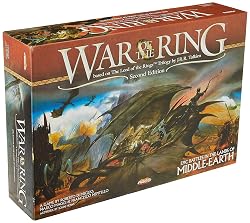 War of the Ring
The definitive grand Tolkien wargame on your table.
If you love The Lord of the Rings, War of the Ring is universally acclaimed as the most thematic, faithful adaptation ever produced in any medium.
- The Hook: One player commands the Free Peoples of Middle-earth; the other commands the Shadow armies of Sauron and Saruman. The Shadow commands near-infinite legions of Orcs, Nazgûl, and Southrons, while the Free Peoples are few, fragile, and divided by reluctant politics.
- The Dual Paths to Victory: The game operates across two intertwined theaters. On the map, armies clash in epic sieges at Helm's Deep, Minas Tirith, and Erebor. Meanwhile, the Fellowship creeps silently toward Mount Doom on a hidden path. The Free Peoples win if Frodo drops the One Ring into the fire, or if their armies capture 4 points of Shadow strongholds. The Shadow wins by conquering 10 points of Free settlements, or by corrupting Frodo's mind.
- The Action Dice System: Each round, players roll custom action dice that dictate their options — moving armies, mustering troops, drawing strategy event cards, or hunting the Ring-bearer. Every turn is a tense balancing act between military conquest and the survival of the Fellowship.
- The Catch: It is massive. Setup takes twenty minutes, the board covers an entire dining table, and a full game takes 3 to 4 hours.
---
Which Box Should You Buy Next?
Choose the box that matches your group's appetite for complexity:
- For the cleanest step up into heavy Euro strategy (3–5 players): Buy Puerto Rico for timeless variable role selection and zero downtime.
- For the ultimate test of economic survival and farm planning: Buy Agricola if your table loves tight worker placement and building against steep odds.
- For the king of card-driven industrial engine building: Pick up Terraforming Mars to assemble a sprawling corporate scientific machine across 200 unique projects.
- For deep engine building in a fast 25-minute package: Buy Race for the Galaxy for infinite replayability and simultaneous play with zero waiting; choose Roll for the Galaxy if your group prefers tactile dice cups.
- For collaborative space tech-tree development (2–4 players): Buy Beyond the Sun to explore exoplanets and build a shared communal scientific branch.
- For the undisputed all-day 8-hour space opera (3–6 players): Invest in Twilight Imperium for grand galactic politics, trade deals, and massive space armadas.
- For an open-world pirate sandbox of high-seas adventure: Buy Merchants & Marauders to live the swashbuckling fantasy of Caribbean trade, tavern rumors, and naval duels.
- For an epic 50-hour dark fantasy Arthurian campaign: Embark on Tainted Grail for deep narrative immersion and lasting world choices.
- For fast, accessible historical miniature battles (2 players): Pick up Memoir '44 for cinematic World War II skirmishes that set up in minutes.
- For a tense samurai bluffing duel of wooden blocks (2 players): Choose Sekigahara: Unification of Japan for hidden unit strengths and defecting traitor daimyos with zero dice.
- For the ultimate Cold War duel of political nerves (2 players): Step up to Twilight Struggle for an unforgettable three-hour clash of diplomatic brinkmanship.
- For the greatest asymmetrical fantasy wargame ever made (2 players): Experience War of the Ring to live the entire Tolkien epic across an afternoon.
As an Amazon Associate we earn from qualifying purchases.