Board games for two
One other person. About an hour. A real duel.
Most board game boxes with a "2–4 players" badge are lying to you. In practice, playing them with two people usually feels like sitting in an echoing hall with two empty chairs. Either the board is too open, the trading mechanics evaporate, or you spend half the time managing artificial "dummy player" rules.
A genuine two-player game is different. Every move is an answer to your opponent, turn downtime is virtually zero, and the victory feels earned rather than accidental.
Here are the tabletop games that actually deliver when there are just two of you across the table, complete with their real strengths and sharpest flaws.
If you want to know which popular multi-player boxes collapse at two, read Board games: When the box says two. If you already bought the wrong one and need a direct swap, check Board games: Buy this, not that. Only have your phones with you? Try Together on this site.
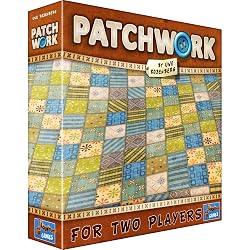 Patchwork
Designed by Uwe Rosenberg, Patchwork turns what sounds like the sleepiest possible hobby — sewing a patchwork quilt — into a razor-sharp spatial duel.
Each player has a blank 9×9 grid. Tetris-like cardboard patches sit in a circle on the table. On your turn, you spend two currencies: buttons (money) and time (steps on a central track). You choose from the next three available patches, pay for it, and fit it into your blanket. When you pass button icons on the time track, your quilt generates income.
- Pros: Plays in 25–30 minutes with zero rules confusion. It has a clever rubber-band turn mechanism: the player further behind on the time track keeps taking turns, so grabbing a tiny 1-step patch might let you move three times in a row. It can be played as a relaxing Sunday afternoon puzzle or as a ruthless hate-drafting bloodbath where you intentionally buy the exact piece your partner needed to finish a row.
- Cons: If one player plans ahead and leaves no empty squares while the other gets stuck with negative point penalties for empty cells, the final score differential can feel demoralizing.
- Alternative: If you want the spatial polyomino puzzle but with cats, card drafting, and more meat on the bone, see Isle of Cats below.
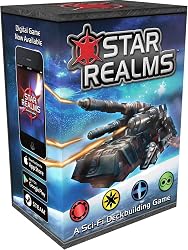 Star Realms
A compact deck-builder in a tiny tuckbox. You start with a personal deck of ten weak scouts and vipers. A shared trade row sits between you with ships and bases from four cosmic factions. Each turn you spend trade points to buy stronger cards into your discard pile, and combat points to attack your opponent's authority down from 50 to 0.
The factions create natural synergies: Trade Federation heals your authority and pumps cash; Blobs hit with brutal raw combat and discard trade row cards; Star Empire forces discards and draws cards; Machine Cult scraps your starting junk so your deck runs like a precision engine.
- Pros: Fast, punchy, and wildly addictive. Several players report getting so hooked on Star Realms that it sidelined the rest of their collection for months. It takes two minutes to set up, packs into a jacket pocket, and offers immense replayability for its price.
- Cons: Pure card draw luck can occasionally give one player an unearned runaway lead if prime faction combos drop into their lap on the trade row. Some people also bounce off the space theme or struggle to grasp deckbuilding from the rule sheet.
- Pro tip: If space ships leave you cold, Hero Realms uses the exact same core engine wrapped in high fantasy (fighters, clerics, wizards) and adds character classes. If the paper rules feel confusing, download the official digital app on your phone: its five-minute tutorial makes the flow click instantly.
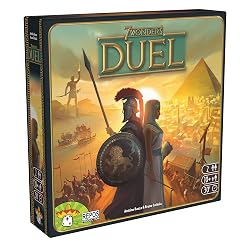 7 Wonders Duel
Rather than taking the classic card-drafting game 7 Wonders and hacking together a two-player dummy variant, the designers threw out the engine and rebuilt it from the ground up for a head-to-head confrontation.
Cards are drafted from a pyramid structure where some cards are face-up and others are face-down beneath them. Taking a card unlocks the cards underneath it for your opponent. You are building city structures, commercial hubs, military camps, and wonders of the world.
- Pros: Unlike most games where you just tally victory points at the end, Duel features three sudden-death paths to victory:
- Military Supremacy: Push the conflict pawn into the enemy capital and the game ends immediately.
- Scientific Supremacy: Collect six different scientific symbols and win on the spot.
- Civilian Victory: If neither happens by the end of Age III, the highest point total takes the game.
- Why this matters: This dynamic completely eliminates passive "point-salad" play. You can never ignore your opponent's board because an unchecked military march will wipe you out in minutes.
- Cons: Setup requires dealing out twenty cards into specific overlapping pyramid patterns each age, which feels slightly fiddly for a card game.
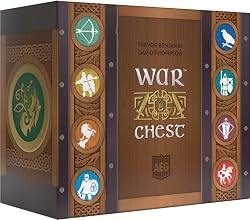 War Chest
If chess were redesigned today with modern European board game sensibilities, you would get War Chest. It combines spatial board tactics with a bag-building mechanism, using heavy, satisfying poker-style chips.
You draft four unit types (like Archers, Knights, Cavalry, or Pikemen). Each unit has unique movement and attack rules. Each turn you blindly draw three chips from your cloth bag. Chips can be discarded to recruit reinforcements, deployed onto the hex board, or discarded to order matching units already on the field to march, attack, or claim control points.
- Pros: Phenomenal component quality. The tactile clack of heavy weighted chips makes every move feel deliberate and weighty. Play is tense, highly tactical, and completely deterministic once a turn begins, yet the blind bag draw introduces just enough unpredictability to prevent rote opening memorization.
- Cons: It is a pure abstract strategy game. If you need lush artwork and narrative flavor to enjoy yourself, chips on a board will feel dry.
- Key Expansion: The Nobility expansion adds royal decree cards that give new powers to the crown token and introduces versatile new units. It is widely considered an essential upgrade once you have ten games under your belt.
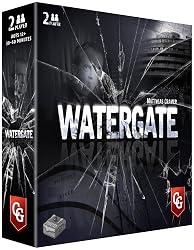 Watergate
A historical political tug-of-war for two players. One plays President Richard Nixon trying to survive until the end of his presidential term; the other plays the Washington Post editor trying to connect two informants directly to Nixon on an evidence corkboard.
Every single card in your hand is multi-use: you can play it for its numeric action value (to tug evidence chips, momentum tokens, and the initiative pawn along a central track) or trigger its specific historic event, which often permanently removes the card from the game.
- Pros: Asymmetric tension from the very first play. The editor feels like an underdog desperately chasing leads before time expires, while Nixon feels besieged and must weigh short-term cover-ups against long-term momentum. Plays in under 45 minutes with virtually zero downtime.
- Cons: Nixon can feel difficult to pilot for absolute beginners who do not yet know the tempo of the journalist's deck.
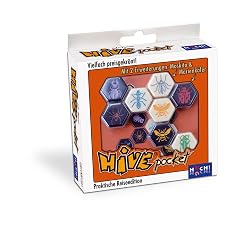 Hive
Hive
A zero-luck abstract game with no board. The pieces are the board. Players place and maneuver heavy hexagonal bakelite tiles depicting insects, with the sole objective of completely surrounding the opponent's Queen Bee.
Each bug moves according to rigid organic rules:
- Ants can scurry around the entire outer rim to any position.
- Grasshoppers jump over occupied tiles in a straight line.
- Beetles crawl up onto other pieces to pin them in place and change the tile's color.
- Spiders must move exactly three spaces along the perimeter.
- The Golden Rule: The "One Hive" rule dictates that pieces can never move in a way that splits the swarm into two separate groups.
- Pros: Indestructible components, water-resistant, zippered travel pouch, zero setup time. It is chess without the memorized twenty-move opening books.
- Cons: Between two seasoned, equally skilled players, Hive can grind into repetitive defensive standoffs. You hop grasshoppers back and forth waiting for the other person to make a micro-mistake. Online competitive play reveals this exhaustion after thirty games.
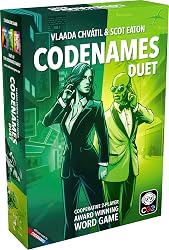 Codenames Duet
Codenames was built as a raucous party game for two competing teams (best at 4 vs 4). Codenames Duet takes the concept and turns it into a tense cooperative mission for two.
You sit across from each other with a grid of 25 word cards. A double-sided key card sits in an upright stand between you:
- You see 9 green words (agents) and 3 black words (assassins).
- Your partner sees a different set of 9 green words and 3 black words on their side.
- Some words overlap; some words that are green for you are assassins for your partner!
You take turns giving one-word clues and a number, hoping your partner taps the green targets without touching an assassin, racing against a tight timer token track.
- Pros: Excellent cooperative brain-burner for couples. You learn how the other person thinks, associations are intimate, and pulling off a win on the final turn generates genuine cheers.
- Cons: The split opinion is fierce. Party purists miss the laughter and trash-talk of team play. Furthermore, the debate between the Words version and the Pictures edition is endless: visual thinkers love surreal imagery, while word traditionalists find the illustrations ambiguous and frustrating.
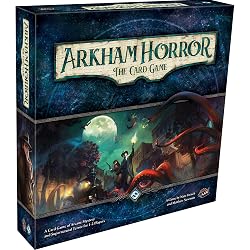 Arkham Horror: The Card Game
If you want a deep, atmospheric story campaign rather than a 30-minute competition, this is the gold standard for two players.
You each choose an investigator, build a custom 30-card deck representing their tools, skills, and personal neuroses, and play through linked narrative scenarios. Decisions branch the storyline: if you burn down a house in scenario one, it remains ashes in scenario three. If your investigator suffers mental trauma, that weakness is permanently shuffled into your deck for future games.
- Pros: Astonishing narrative atmosphere. Instead of rolling dice, skill checks draw tokens from a blind "chaos bag," allowing you to calculate statistical risks and hedge your bets. You genuinely feel like vulnerable detectives unraveling Eldritch mysteries in 1920s Massachusetts.
- Cons: Financial commitment. The revised core set is effectively a three-scenario tutorial. To get the true experience, you have to buy full campaign cycles. It also requires deck construction between sessions, which appeals to hobbyists but turns off casual players who just want to unpack a box and roll.
- Detailed comparison: For how the card game compares to Eldritch Horror and Mansions of Madness, read Lovecraft on the table.
Also Built for Two
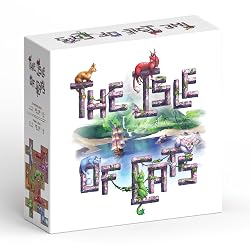 Isle of Cats: A card-drafting, cat-rescuing polyomino puzzle. Offers both a deep regular game and a simplified family mode. Excellent if you want spatial layout with richer decisions than Patchwork.
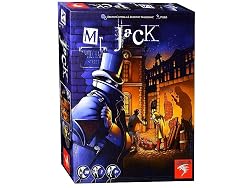 Mr. Jack (London / New York): Asymmetric cat-and-mouse deduction. One player is Jack the Ripper disguised as one of eight detectives; the other is the investigator using light and shadow to narrow down suspects.
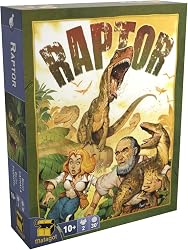 Raptor: One player controls an escaped mother Velociraptor trying to rescue her babies; the other plays scientists trying to capture them. Fast, tactical, clever action-selection cards.
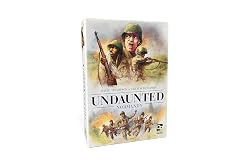 Undaunted: Normandy: Blends deckbuilding with World War II squad tactics on a modular board. You use cards to order riflemen, machine gunners, and scouts through French hedgerows.
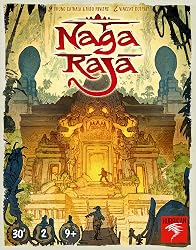 Nagaraja: An Indian temple duel where you roll wooden fate sticks to draft temple tiles and race to find ancient sacred relics before uncovering cursed ones.
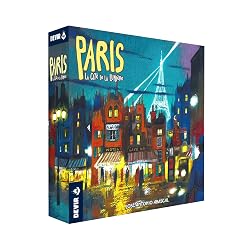 Paris: La Cité de la Lumière: Set during the 1889 World's Fair. Phase one is laying street cobblestones and claiming streetlamps; phase two is placing polyomino buildings under the light. Elegant and cutthroat.
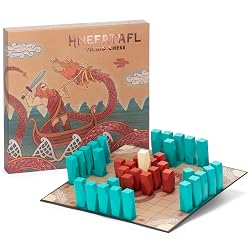 Hnefatafl (Viking Chess): Ancient asymmetric game where a Viking king and his guards in the center must fight their way to a corner while a superior besieging force surrounds them.
 Love Letter: A micro-game masterpiece with a 16-card deck, but it is tedious with two players. It requires three or four to generate the necessary bluffing, deduction, and table stakes.
As an Amazon Associate we earn from qualifying purchases.